
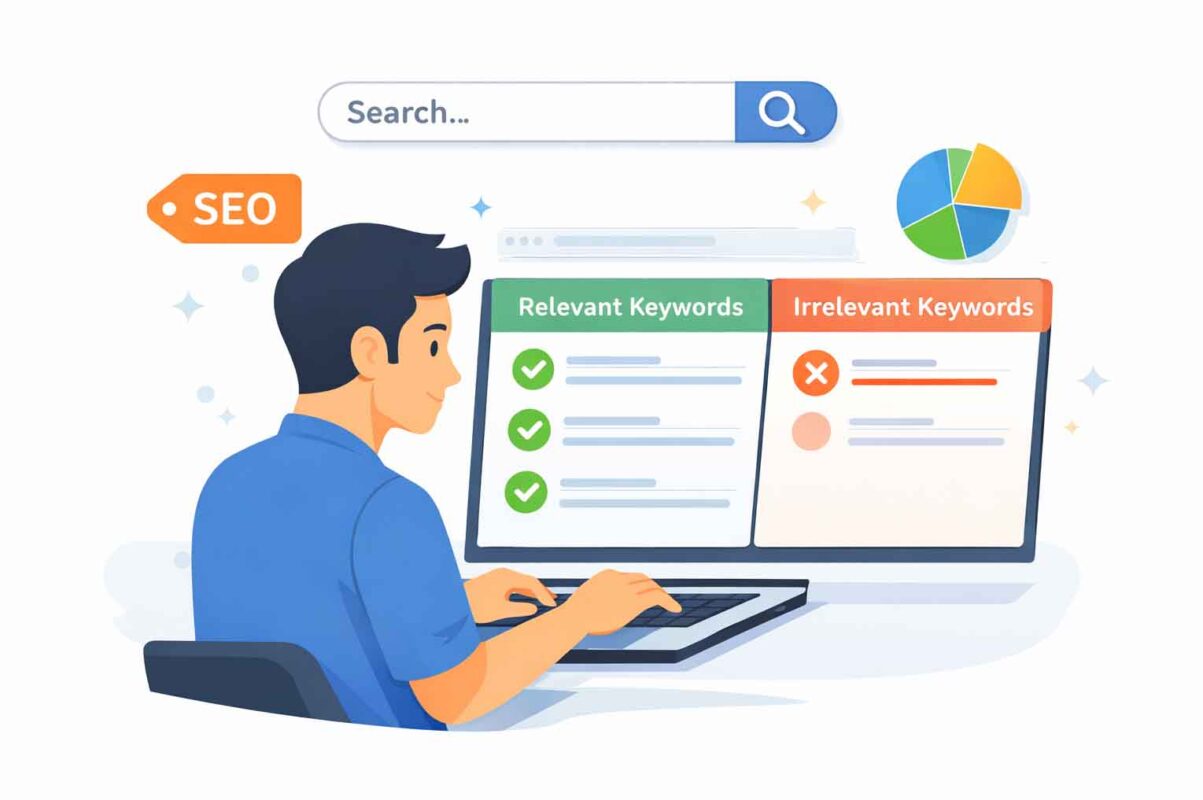
Understanding Keyword Relevance: Why Most SEO Strategies Fail
Many marketers and business owners begin their SEO journey with a surge of energy. They subscribe to expensive tools, export massive spreadsheets of data, and celebrate when they find keywords with tens of thousands of monthly searches. The logic seems simple: “If I rank for this high-volume term, my business will explode.”
Yet, months later, the results are often disappointing. The site might be getting hits, but the sales aren’t moving. Or, perhaps more frustratingly, the site climbs to the first page for a week, only to plummet into obscurity shortly after.
The missing link is almost always Keyword Relevance. This is the invisible filter that determines whether your SEO efforts result in actual business growth or just a collection of vanity metrics.
What Exactly is Keyword Relevance?
Keyword relevance is the measure of how closely a specific search term matches the content on a webpage and the actual intent of the person searching. It is the bridge between a user’s problem and your solution.
True relevance occurs at the intersection of three specific elements:
-
Search Intent: What is the user trying to accomplish? (Information, purchase, or navigation?)
-
Content Accuracy: Does your page provide a comprehensive and direct answer to the query?
-
Business Alignment: Does this specific keyword attract the person who actually needs your product or service?
Why Keyword Relevance is the Foundation of SEO
1. Attracting the “Right” Traffic vs. “Any” Traffic
The most dangerous trap in digital marketing is the pursuit of raw traffic. High traffic numbers look great in monthly reports, but they don’t pay the bills.
Consider a business that sells high-end, custom-built road bikes costing $5,000 each. If they optimize their website for the keyword “cheap bicycles,” they might successfully attract thousands of visitors. However, those visitors are looking for budget options. When they see the $5,000 price tag, they will leave immediately.
In this scenario, the traffic is high, but the relevance is zero. You haven’t just failed to make a sale; you’ve wasted server bandwidth and skewed your data with “junk” leads.
2. Satisfying the Google Algorithm (The Bounce Rate Factor)
Google’s primary goal is to provide the best possible answer to a user’s question. They use “user signals” to determine if a page is relevant.
If a user clicks on your link for the keyword “how to fix a leaky faucet” but finds a page trying to sell them a new faucet without giving any repair tips, they will immediately click the “back” button. This is known as Pogo-sticking. When Google sees users leaving your site within seconds to go back to the search results, it receives a clear signal: This page is not relevant to this keyword. Consequently, Google will drop your ranking to protect the user experience.
3. The Power of Search Intent
Relevance is deeply tied to why someone is searching. There are generally four types of intent:
-
Informational: “How does photosynthesis work?”
-
Navigational: “Facebook login.”
-
Commercial Investigation: “Best DSLR cameras 2024.”
-
Transactional: “Buy Nikon D850 online.”
If you target a transactional keyword with an informational blog post, or vice versa, your relevance score is low. A user looking to “buy” is frustrated by a 3,000-word history lesson, and a user looking for “how-to” info is put off by a high-pressure sales page.
The Trap of High-Volume Keywords
Beginners are often drawn to “Head Terms”—short, broad keywords with massive search volumes. For example, the keyword “Coffee” has millions of searches. But what is the searcher looking for?
-
The history of coffee?
-
A local cafe?
-
To buy beans online?
-
A recipe for Dalgona coffee?
Because the intent is so broad, it is nearly impossible to create a “relevant” page for everyone. This is where Long-Tail Keywords become the hero of your strategy. A keyword like “organic fair-trade dark roast coffee beans” has lower volume, but the relevance is incredibly high. The person typing that knows exactly what they want, and if you provide it, your conversion rate will skyrocket.
How to Audit Your Keyword Relevance
To avoid the common pitfalls of failed SEO, you must ask three critical questions before committing to a keyword:
1. Does this keyword solve the user’s “Primary Pain Point”? If someone searches for a term, they have a problem or a curiosity. If your content doesn’t address that specific issue within the first two paragraphs, you aren’t relevant.
2. Is this keyword used by my Buyer Persona? Review your ideal customer profile. Does your customer actually use this terminology? Often, businesses use “industry jargon” that their customers never actually type into a search engine.
3. Does the “Search Engine Results Page” (SERP) match my content type? Search the keyword yourself. Are the top results videos? Are they product pages? Are they long-form articles? If Google is showing 10 videos for a keyword and you are trying to rank a text-only page, Google has already decided that text is not the “relevant” format for that query.
Summary: The Path to SEO Success
SEO failure isn’t always about a lack of backlinks or technical errors. More often, it’s a failure to be relevant. By shifting your focus from “How can I get more clicks?” to “How can I be the most relevant answer for my ideal customer?”, you create a sustainable SEO strategy. Relevant traffic stays longer, engages more, and ultimately converts into loyal customers.
The Smart SEO Strategy:
-
Relevance: The foundation.
-
Authority: The engine (Backlinks/Trust).
-
Technical: The vehicle (Site speed/Code).
Search Volume vs Keyword Difficulty
Understanding Keyword Relevance: Why Most SEO Strategies Fail
Without the foundation of relevance, the engine and the vehicle have nowhere to go.
FAQ Section
Yes. Without relevance, even high search volume will not produce real business results or conversions.
Absolutely. Many low-volume keywords are highly specific (long-tail), meaning they often have high intent and much higher conversion rates.
You can check it by analyzing search intent, performing a SERP (Search Engine Results Page) analysis, and aligning the keyword with your buyer persona.
Yes, as long as the keywords share the same search intent and the content supports them naturally without keyword stuffing.
