
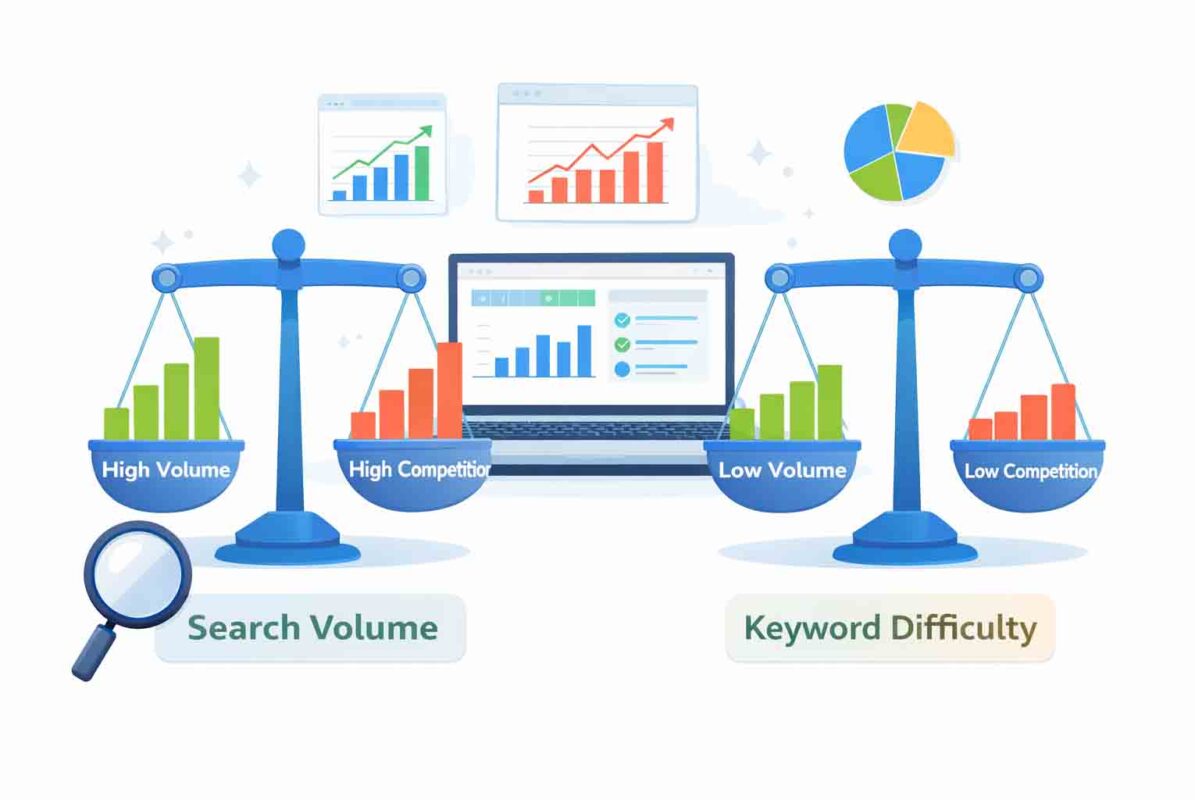
Search Volume vs. Keyword Difficulty: How to Find the Perfect SEO Balance
When you first step into the world of SEO, the first thing that usually catches your eye is the data. Specifically, those massive Search Volume numbers. You open a keyword tool, and you see a phrase with 50,000 monthly searches. It’s natural to think, “If I can just rank for this one keyword, my business will be set for life.”
Fast forward six months: the website has no rankings, the traffic graph is a flat line, and you’re convinced SEO doesn’t work.
The reality? SEO works perfectly; the strategy failed because of a lack of balance. Chasing high search volume without considering Keyword Difficulty is like trying to enter a professional heavyweight boxing match when you’ve never hit a gym. You might have the ambition, but the competition will knock you out before you land a single punch.
In this guide, we will break down the relationship between volume and difficulty, identify the “Sweet Spot” for growth, and explain why a balanced approach is the only way to win in 2026.
Understanding Search Volume: The “Popularity” Metric
Search Volume represents the average number of times a specific keyword is entered into Google per month.
-
Broad Keyword: “Aquascaping” → 25,000 searches/month
-
Specific Keyword: “Low light plants for betta tank” → 200 searches/month
A common misconception is that Higher Volume = More Profit. While volume indicates interest, it doesn’t always indicate a path to success.
The Pitfalls of High-Volume Keywords
-
Vague Search Intent: When someone searches for a broad term like “Aquarium,” Google isn’t sure if they want to buy one, see a picture of one, or find a local public aquarium. Because the intent is “blurry,” your content might not satisfy the user.
-
The Authority Barrier: High-volume terms are almost always dominated by “Goliath” websites—brands with massive budgets, thousands of backlinks, and decades of domain authority.
-
Lower Conversion Rates: High-volume traffic is often “browsing” traffic. People are looking for information or inspiration, not necessarily looking to open their wallets.
Understanding Keyword Difficulty: The “Competition” Metric
Keyword Difficulty (KD) is an estimate of how hard it is to rank on the first page of Google for a specific term. Most SEO tools calculate this on a scale of 0 to 100.
-
KD 0–20 (Easy): You can often rank with good content and basic on-page SEO.
-
KD 21–50 (Medium): You will likely need some quality backlinks and a solid internal linking structure.
-
KD 51+ (Hard/Very Hard): Requires significant authority, a massive backlink profile, and high-level technical SEO.
It’s important to remember: Difficulty isn’t a “No.” It’s a “Not yet.” If you have a brand-new website, targeting a KD 70 keyword is a waste of resources. That keyword should be your long-term goal, not your starting point.
The Balancing Act: Finding the “Sweet Spot”
Successful SEO is about making smart bets. You have limited time and budget; you must spend them where they will yield the highest return. Let’s look at three common scenarios:
Scenario 1: The “Vanity” Trap (High Volume + High Difficulty)
-
Example: “Best Laptops” (Volume: 150k, KD: 85)
-
Outcome: You spend months writing a 5,000-word guide, but you remain on page 10 of Google. You get zero traffic.
-
Verdict: Avoid this for now. Save it for when your site is an established authority.
Scenario 2: The “Niche” Play (Low Volume + Low Difficulty)
-
Example: “Best silent filter for 5-gallon shrimp tank” (Volume: 80, KD: 5)
-
Outcome: You rank #1 within two weeks. You only get 40 visitors a month, but those 40 people are looking for a very specific product you sell.
-
Verdict: Highly valuable for conversions and building initial momentum.
Scenario 3: The “Sweet Spot” (Medium Volume + Low/Medium Difficulty)
-
Example: “Easy aquascaping ideas for beginners” (Volume: 800, KD: 22)
-
Outcome: With a well-structured article and a few internal links, you reach the top 5. You get steady, relevant traffic every single day.
-
Verdict: This is where the magic happens. Especially for new or growing websites.
Why Beginners Should Target the “Sweet Spot”
If you are a beginner, your goal shouldn’t be to “beat” the big guys immediately. Your goal is to build a topical map.
By targeting medium-to-low difficulty keywords that are highly relevant to your niche, you start winning “mini-battles.” Each time you rank for a KD 15 keyword, Google starts to trust you more as an expert in that topic. This “Topical Authority” eventually makes it easier for you to rank for higher-difficulty keywords later on.
Common Strategy Mistakes to Avoid
-
Ignoring Zero-Volume Keywords: Sometimes tools say a keyword has “0” volume, but it’s actually a brand-new trend or a very specific question. These can be goldmines because they have zero competition and 100% relevance.
-
Trusting Tools Blindly: KD is an estimate. Always manually check the Search Engine Results Page (SERP). If the top 10 results are all Reddit threads or Quora posts, the keyword is likely easier than the tool says.
-
Forgetting Relevance: Never pick a keyword just because the numbers look good. If it doesn’t relate to your business or help your “Buyer Persona,” the traffic is useless.
The Roadmap for a Balanced Strategy
To build a sustainable SEO plan, follow this hierarchy of decision-making:
-
Step 1: Relevance First. Does this keyword attract my target customer?
-
Step 2: Intent Second. Is the user looking for what I am providing?
-
Step 3: Difficulty Third. Can I actually rank for this within the next 3–6 months?
-
Step 4: Volume Fourth. Is there enough interest to justify the effort?
SEO is a marathon, not a sprint. Choosing a keyword with 500 searches that you can actually win is infinitely better than choosing one with 50,000 searches that you will never reach.
More content and more information —
👉 Keyword Research Recap
👉 Keyword Relevance
Search Volume & Keyword Difficulty FAQ
It depends entirely on your niche and business model. If you sell $10,000 software, a volume of 50 searches a month is fantastic. If you run a celebrity gossip blog, you might need keywords with 10,000+ volume to make ad revenue. Focus on the value of the visitor, not just the number.
SEO tools use historical data and clickstream data, which isn’t always up to date. If you see people talking about a topic on social media or forums, it has volume. Trust your niche knowledge over the tool.
It is extremely rare and usually requires a “viral” amount of high-quality backlinks in a short time. It is much more efficient to rank for 10 low-difficulty keywords than to fight for one high-difficulty term.
No. Semrush, Ahrefs, and Moz all use different formulas to calculate KD. It is best to stick to one tool for consistency, but always verify the competition by looking at the actual Google search results.
Rarely. Low-volume content helps build your site’s overall “topical authority.” As long as the content is high-quality and relevant, it serves as a foundation that helps your higher-volume pages rank better.
