The Ultimate Keyword Research Masterclass: A Comprehensive Guide for 2026
In the vast world of Digital Marketing, there is a fundamental truth: “Content is King, but Keywords are the Kingdom.” You can write the most beautiful, well-researched article in the world, but if you don’t target the specific terms people are searching for, your content will remain buried under millions of other pages. This guide is designed to take you from an absolute beginner to a keyword strategist, helping you understand how to find “Gold Keywords” that drive real traffic and revenue.
1. What is Keyword Research? (The Simple Truth)
At its core, Keyword Research is the process of discovering the exact language your target audience uses when they turn to search engines like Google. It is much more than just finding words with high numbers; it is about Market Research.
When you perform keyword research, you are essentially “listening” to your customers. You learn about their pain points, their deepest questions, and their buying habits. By the end of this process, you will know exactly what content to create to meet their needs.
2. Why is Keyword Research the Foundation of SEO?
Keyword Research is the compass of your SEO journey. Without it, you are traveling without direction.
-
Targeting the Right Audience: It ensures you aren’t just getting traffic, but the right traffic.
-
Saving Resources: Instead of writing 100 random articles, you can write 10 articles that you know people are searching for.
-
Competitive Edge: It helps you find “gaps” in the market where your competitors are weak.
3. The Keyword Spectrum: Short-tail vs. Long-tail
To build a successful strategy, you must understand the two ends of the keyword spectrum.
Short-tail Keywords (The Giants)
Short-tail keywords are broad, 1–2 word phrases like “SEO” or “Aquarium.” * The Allure: They have massive search volumes (millions of searches).
-
The Danger: The competition is legendary. You are fighting against multi-billion dollar companies and decades-old websites.
-
The Flaw: The Search Intent is vague. Does the person searching for “Aquarium” want to see fish photos, buy a tank, or find a museum? You simply don’t know.
Long-tail Keywords (The Goldmine)
Long-tail keywords are specific, 3–5+ word phrases like “best low-light plants for a small freshwater aquarium.”
-
The Opportunity: The competition is significantly lower, making it easy for new websites to rank.
-
The Power: The Search Intent is crystal clear. You know exactly what the user wants.
-
The Result: Even though they have lower traffic individually, they lead to much higher Conversion Rates. People searching for specific solutions are much closer to making a decision or a purchase.
4. Starting the Journey: Seed Keywords
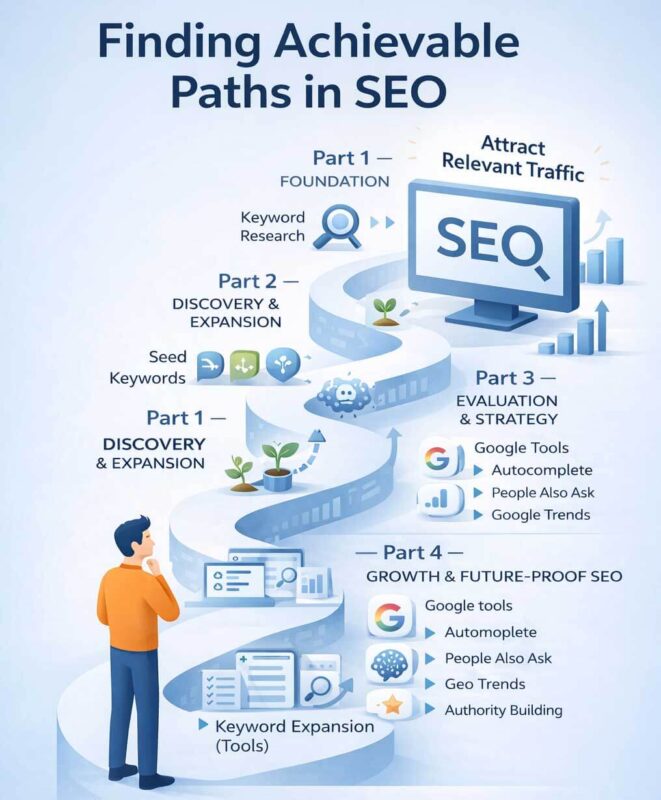
Before you open any fancy SEO tool, you need Seed Keywords. These are the “starting points” for your research. They are the broad themes of your niche.
How to Brainstorm Seeds:
-
Analyze your Niche: What are the 5 main topics you will cover? (e.g., Aquascape, Fish Health, Aquarium Tech).
-
User Problems: What keeps your audience awake at night? (e.g., “Why is my fish dying?”).
-
The “Mind-Reader” Question: If you were the customer, what are the first 5 things you would type into Google?
5. Expanding the List: Using Ubersuggest
Once you have your seeds, it’s time to grow them into a “Keyword Forest.” Tools like Ubersuggest are perfect for beginners because of their simple interface.
-
The Expansion: Enter a seed like “Planting Tanks.” The tool will give you hundreds of variations.
-
The Questions Tab: This is a goldmine for informational content. Look for phrases starting with “How,” “Why,” and “When.”
-
The Comparison Tab: Look for keywords like “A vs B.” These are high-value commercial keywords where users are deciding which product to buy.
6. Understanding the Data: Volume and SEO Difficulty (KD)
Now that you have a list of 1,000+ keywords, you need to filter them. Two metrics matter the most:
Search Volume
This is the estimated number of monthly searches.
-
Strategy: For a new site, don’t ignore “Low Volume” keywords (50-200 searches). If the intent is high, these 50 people are much more valuable than 5,000 random people.
SEO Difficulty (KD/SD)
This is a score from 0–100 that tells you how hard it is to rank.
-
The 0–30 Rule: If your website is new, focus exclusively on keywords with a difficulty score of 30 or less. These are your “Easy Wins” that will help you build momentum and authority.
7. The Power of “Question Keywords”
In 2026, search engines are shifting from “Matching Keywords” to “Answering Questions.” People now use voice search and AI assistants. They don’t just type “Aquarium algae”; they ask, “How do I get rid of green algae in a small tank?”
Targeting question-based keywords is the fastest way to:
-
Get featured in the “People Also Ask” boxes.
-
Show up in AI Overviews (SGE).
-
Build trust by being the “Teacher” in your niche.
8. Leveraging Google as a Free Tool
Paid tools are great, but Google itself is the most accurate source of data. Always check:
-
Google Autocomplete: The suggestions that appear as you type. These are real-time trending queries.
-
Related Searches: Found at the bottom of every search result page. These are excellent for finding “Supporting Content” for your main articles.
-
Google Trends: Use this to see if a topic is growing over the years or if it is just a temporary fad.
9. Content Clustering: The Modern Way to Rank
Google no longer ranks just “pages”; it ranks “Topic Authority.” Instead of writing random posts, use your keywords to create Content Clusters.
-
Pillar Post: A massive guide on a broad seed keyword (e.g., The Ultimate Guide to Aquascaping).
-
Cluster Posts: 10 smaller articles targeting long-tail keywords related to the pillar (e.g., Best rocks for aquascaping, CO2 for beginners, DIY substrate).
-
Internal Linking: Link all cluster posts back to the pillar. This tells Google that you are a complete expert on the subject.
10. The GEO Mindset: SEO for the AI Era
We are entering the era of Generative Engine Optimization (GEO). AI models like Gemini and ChatGPT now summarize the web. To stay relevant:
-
Be Concise: Answer the user’s primary question in the first paragraph.
-
Be Original: AI loves data and personal experiences that it can’t find elsewhere.
-
Be Structured: Use tables, bullet points, and clear headings.
11. Filtering Your Way to the “Gold”
After your research, you should have a “Shortlist” of keywords. Your ideal keyword should fit this criteria:
-
High Relevance: It fits your niche perfectly.
-
Low Difficulty: KD is under 30.
-
Clear Intent: You know exactly what the user wants to see.
-
Sustainable Volume: At least 100+ people are searching for it.
12. Conclusion: Strategy Beats Luck
SEO is often seen as a mystery, but it is actually a Strategy. When you align your content with the specific Keywords and Intent of your audience, you stop hoping for traffic and start planning for it.
By starting with Long-tail Keywords, using Seed Keywords to build clusters, and respecting the Helpful Content System, you are building a website that doesn’t just rank—it dominates. Stop chasing the algorithm and start serving the user. That is the only “hack” you will ever need.
Frequently Asked Questions
