
The Ultimate Guide to Modern SEO: How Google Actually Works in 2026
If you ask anyone what SEO was ten years ago, they would say one thing: Backlinks. It didn’t matter if your content was rubbish. If you could spam enough links across the internet, you would rank #1.
But today? That strategy is a one-way ticket to getting banned by Google.
Google has become incredibly smart. With updates like the Helpful Content System, Google now acts more like a human librarian than a robot. It rewards quality, punishes manipulation, and focuses entirely on the user experience.
In this guide, we will break down the “secret formula” of SEO and give you a step-by-step checklist to dominate the search results.
The 4 Pillars of SEO: Your Foundation for Success
To understand SEO, you don’t need to be a coder. You just need to master these four pillars. Every single SEO task—from writing a blog to fixing a link—falls into one of these categories.
1. On-Page SEO (The Content)
This is what you do on your actual website. It includes your keyword placement, your headings, and the value of your information.
-
Pro Tip: Don’t just “stuff” keywords. Use them naturally so the reader doesn’t get annoyed.
2. Off-Page SEO (The Reputation)
This is your website’s “social status.” When other high-quality websites link to you, Google sees it as a vote of confidence. In Indian English terms: it’s your “market value.”
3. Technical SEO (The Engine)
If your website is slow or doesn’t work well on a mobile phone, no amount of good content will save you. Technical SEO ensures that Google’s bots can enter your site and read your pages without any errors.
4. Algorithm Understanding (The Rules)
Google changes its rules thousands of times a year. You need to understand the “why” behind these changes to stay ahead of your competitors.
How Google Works: A 3-Step Journey
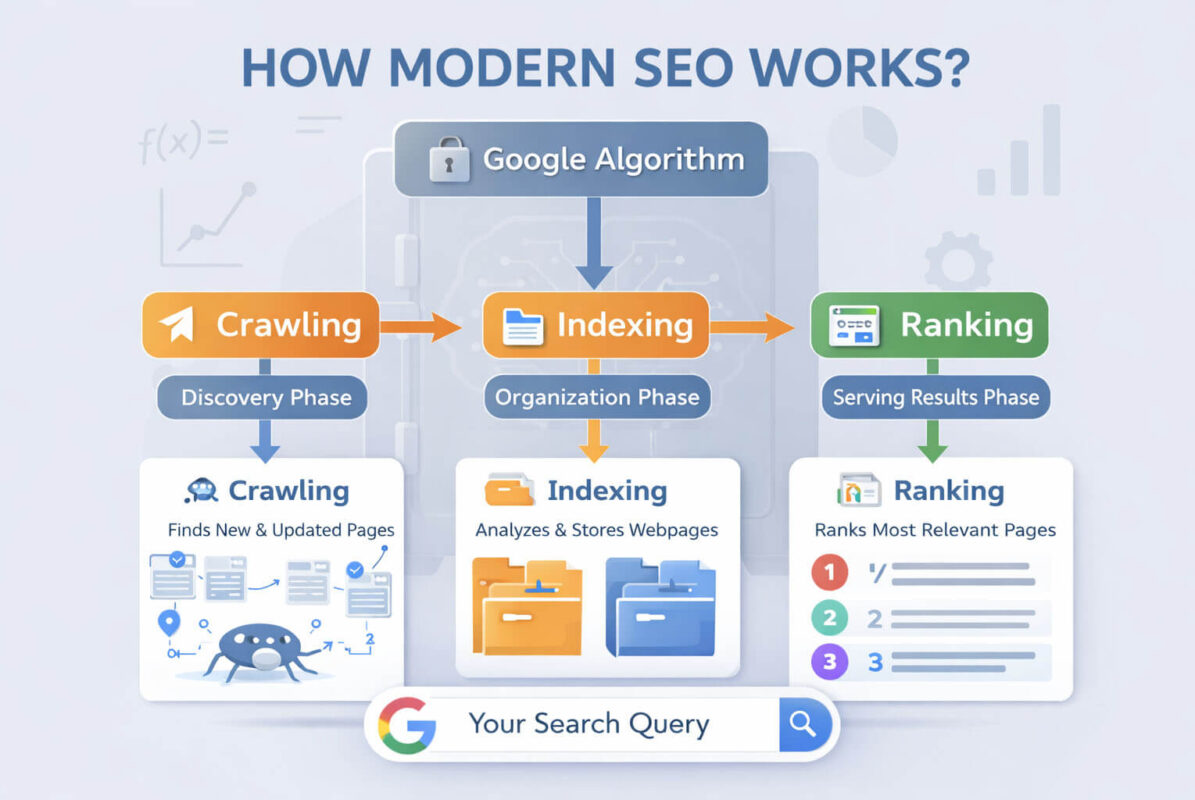
Many people think Google is magic. It’s not. It follows a very logical 3-step process: Crawling, Indexing, and Ranking.
Step 1: Crawling (The Discovery)
Google uses software called Googlebot (or spiders). These bots crawl the internet by following links.
-
Think of it like a spider moving across a massive web. If your page isn’t linked to anything, the spider can’t find it. This is why Internal Linking is crucial.
Step 2: Indexing (The Library)
Once the bot finds your page, it reads the content, images, and videos. It then “files” this information in a massive digital library called the Index.
-
The Site Operator Trick: Want to see if Google has filed your site correctly? Go to Google and type: site:yourdomain.com If your pages show up, you are indexed!
Step 3: Ranking (The Competition)
When someone searches for a keyword, Google looks through its library and picks the best 10 results. It looks at over 200 “signals,” including your speed, your authority, and how helpful your content is.
The Ultimate Step-by-Step SEO Checklist
Use this checklist to ensure your website is perfectly optimized.
Part A: Technical Setup
-
Google Search Console: Connect your site to see how Google views your traffic.
-
Sitemap: Create and submit an XML sitemap so Googlebot knows your site structure.
-
Robots.txt: Ensure you aren’t accidentally “blocking” Google from seeing your important pages.
-
SSL (HTTPS): Make sure your site is secure. Google hates “Not Secure” websites.
-
Mobile Speed: Use Google PageSpeed Insights. If your site takes more than 3 seconds to load, you’re losing money.
Part B: On-Page Optimization
-
Keyword Intent: Are you answering the user’s question? Don’t just write; solve a problem.
-
Title Tags: Keep your main keyword at the beginning of the title.
-
H1 & H2 Tags: Use only one H1 tag per page. Use H2s for subheadings to make the text scannable.
-
Image Alt Text: Bots can’t “see” images. Tell them what the image is using Alt tags.
-
Internal Links: Link to at least 2-3 of your other relevant blog posts.
Part C: Content & E-E-A-T
-
Experience: Do you have personal experience with this topic? Mention it.
-
Expertise: Show your credentials or link to your social profiles.
-
Authoritativeness: Write deep, long-form content (like this guide!) to show you are an expert.
-
Trust: Ensure your “About Us” and “Contact” pages are clear and professional.
Why Google Algorithms Keep Changing
The #1 question I get is: “Why does Google change the rules so often?”
The answer is simple: To stop the spammers. Every time someone finds a “trick” to rank #1 without providing value, Google updates its system to block that trick. This is why White-Hat SEO is the only way to survive. If you focus on the user, you never have to fear a Google update.
Conclusion: SEO is a Marathon, Not a Sprint
You won’t see results tomorrow. Real SEO takes time—usually 3 to 6 months to see significant movement. But once you start ranking, you get free, high-quality traffic every single day.
Follow the 4 pillars, keep an eye on your crawling and indexing, and always put the reader first.
Faq
Ranking drops usually happen for three reasons:
-
A Google Algorithm Update: Google changed its rules.
-
Technical Issues: Your site became slow or has broken links.
-
Competitors: Someone else wrote a better, more updated piece of content than yours.
